

| |
| |
|
|
|
RIK VERMEERSCH (°1949) |
|
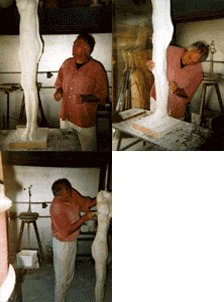
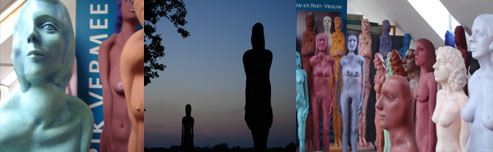
In 1967, as a reaction to ‘the beautification of reality which distorts art’, Rik Vermeersch began depicting and painting people in their everyday appearance. He draws his inspiration from magazines and newspapers in which he looks at humankind more as an object than a subject. This enables him purely to put on the ‘presence’. The ‘object-ification’ which is so typical of his work then becomes increasingly clear. His drawings and paintings took on a more digital character from 1970 onwards. To the sheer amazement of the painter himself, this technology displays an analogous identity with the image formation of a computer print. From 1980, he began to do sculptures as well as drawings and paintings. Early in the 1990s, due to the ‘erotic surplus’, Vermeersch began to choose women as his main theme. Photography lays the foundation for his drawings, paintings and sculptures. He himself photographs his models, divested of as many ‘subjectives’ as possible. They pose nude, frontally, motionless and isolated, with a facial expression which suppresses any emotion. Since 2006, in his drawings and paintings the model has re-appeared
in a real environment. The static, naked female is now less clearly
the main object. She shares her place with portraits (e.g. from magazines
and newspapers) with other males and females who may or may not be
in motion and fully clothed. |
| To support his work, Rik Vermeersch likes
to refer back to the quotation below from ‘Letters on Cézanne’ by
Rilke.
"My only desire is to behold and express reality, without selection or idealization, as mere ‘being’. Confirm the objects in their ‘exploitive’ reality. Work with unconditional devotion, day in day out, and show perseverance without real joy and sometimes against your better judgement. Work away, focused solely on a goal which can only be achieved a few times in life, only to have to start again at the very beginning."
|